The Safe Haven Shatters: The Panic Pullback of Pakistani Billions from Dubai
Dubai has served as the ultimate safety deposit box for Pakistan’s elite, a $12.5 billion offshore empire built on capital that fled the "fiscal guillotine" of Pakistan's industrial decline. But in 2026, the illusion of the safe haven has violently shattered.

Liam Carter
Introduction: The Offshore Illusion
For decades, Dubai has been the ultimate safety deposit box for Pakistan's elite. From high-net-worth individuals to corporate conglomerates and corrupt politicians, the UAE was the promised land for parking capital, a sun-drenched jurisdiction where questions were not asked, taxes were not levied, and the money of a struggling nation could be quietly transformed into Palm Jumeirah villas and Marina high-rises.
The numbers, when they finally emerged through leaked data, were staggering. The "Dubai Unlocked" investigation, coordinated by the Centre for Advanced Defence Studies (C4ADS), the Organised Crime and Corruption Reporting Project (OCCRP), and 74 media outlets across 58 countries Profit by Pakistan Today, peeled back the curtain on what Pakistanis had quietly constructed offshore. While 17,000 Pakistani citizens are listed as owners in the 2022 leak, academics using the data and additional sources put the actual number of Pakistani owners of residential property in Dubai at 22,000, estimating the apartments and villas were worth more than $10 billion at the start of 2022. With the subsequent 25% increase in property prices, the real worth of Pakistanis' residential properties in Dubai could be well above $12.5 billion. Profit by Pakistan Today
To understand the full scale of the heist, you need the longer historical arc. According to the Atlas of the Offshore World, compiled by the EU Tax Observatory and Norway's Skatteforsk Centre for Tax Research, offshore financial wealth owned by Pakistan has declined from nearly 17% in 2001 to 2% in 2022, largely on account of increasing transparency in the global banking system. In 2001, Pakistan's offshore financial wealth stashed away in Switzerland was $11 billion. In 2022, that figure was down to $1 billion. Profit by Pakistan Today The money did not come home. It simply found a new hiding place. Growing transparency in the banking system incentivised a shift towards real estate, and Dubai is the favoured destination by far. London, with $740 million, comes in a distant second behind Dubai for Pakistanis looking to invest in offshore real estate. Profit by Pakistan Today
This was not merely wealthy individuals making legitimate investment decisions. This was a systematic, decades-long hollowing of Pakistan's productive economy, textiles, manufacturing, financial services, with the extracted wealth parked in a jurisdiction designed to ask no questions. But in 2026, the geopolitical tectonic plates have shifted violently. The safe haven has cracked. And the panic has officially set in.
The Cast of the Offshore Drama
The Dubai Unlocked data did not merely reveal the scale of Pakistani offshore wealth. It revealed exactly who was doing it.
Pakistanis listed in the leaks include President Asif Ali Zardari's three children, former Prime Minister Nawaz Sharif's son Hussain Nawaz Sharif, Interior Minister Mohsin Naqvi's wife, Sindh provincial minister Sharjeel Memon and family members, Senator Faisal Vawda, and half a dozen lawmakers from the Sindh and Balochistan assemblies. QOSHE
The military dimension is equally damning. The Pakistani list also features the late Gen. Pervez Musharraf, former Prime Minister Shaukat Aziz, former army chief Qamar Javed Bajwa's son, and more than a dozen retired army generals, as well as a police chief, an ambassador, and a scientist, all of whom owned properties either directly or through their spouses and children. QOSHE
Among the more specific revelations: Interior Minister Mohsin Naqvi's wife owns a five-bedroom villa in Arabian Ranches. She received a rental income of AED600,000 (approximately Rs45 million) from the villa, which was purchased in August 2017 for AED 4.35 million. The villa was later sold in April 2023 for AED 4.55 million. Economy
The response from Pakistan's ruling class to these revelations was predictably uniform. Top Pakistani politicians dismissed the leaks, saying all mentioned assets had been legally declared. QOSHE Not a single significant prosecution followed. Not a single asset was repatriated. The FBR Chairman at the time offered a careful formulation: "If we have the data you are talking about, as well as the information on residence status, we will make sure those who are eligible to pay tax in Pakistan on rental income or capital value are doing so. It may be a sensitive matter, and perhaps the law will have to change, but with political will we will go all out against tax evaders." Profit by Pakistan Today
The political will, of course, never materialized. The people who set Pakistan's tax policy were, in many cases, the same people whose families owned the Dubai properties.
It is essential to understand what this capital actually represents. Much of it is not simply legitimate savings or declared investment income. As the EU Tax Observatory noted in its Global Tax Evasion Report 2024, "real estate is a particularly serious blind spot in international information exchange. Just like financial assets, there are many legitimate reasons for holding real estate abroad, but there are also concerns that offshore real estate, in some cases, may be used for money laundering, tax evasion, escaping international sanctions, or other financial crimes. The attractiveness of real estate as an asset class lies in its relatively stable value over time, the possibility to manipulate prices, and possibilities for anonymous ownership in countries with weak property registers." Profit by Pakistan Today
The Pandora Papers added another layer. Pakistan's Finance Minister Shaukat Fayaz Ahmed Tarin and several members of Pakistan's top generals' families were named in the 11.9 million leaked documents that exposed the secret offshore accounts of world leaders and business elites. The News In a rare glimpse of how top military officers use offshore structures while maintaining the military's image as a bulwark against civilian corruption, leaked documents revealed that in 2007, the wife of Gen. Shafaat Ullah Shah, then one of Pakistan's leading generals and a former aide to President Musharraf, acquired a $1.2 million apartment in London through a discreet offshore transaction. Geo News
This is the world's most brazen class of tax evaders: the same people who demand sacrifice from Pakistan's population, who lecture about national resilience, who preside over the FBR's extraction machine, quietly stacking villas in a jurisdiction that asks nothing of them.
The UAE's Regulatory Transformation: The End of "No Questions Asked"
Even before the missiles started flying, the Dubai that Pakistan's elite had relied upon was already changing in ways that threatened their arrangements.
For years, the UAE's regulatory posture on money laundering was effectively a competitive advantage. Minimal scrutiny of beneficial ownership, cash-friendly real estate transactions, and a culture of discretion made it the premier destination for capital that could not withstand examination. That posture began to unravel in March 2022, when the FATF placed the UAE on its grey list for jurisdictions subject to increased monitoring, identifying strategic deficiencies in the UAE's efforts to prevent money laundering and terrorist financing. Dawn
The consequences were immediate and serious. UAE financial institutions faced heightened correspondent banking scrutiny globally. Real estate transactions came under closer examination. And the UAE government, understanding the existential threat to its status as a financial hub, embarked on a sweeping reform program. After a subsequent onsite inspection to verify the implementation of reforms, the UAE was formally removed from the FATF grey list on 23 February 2024. Dawn But removal from the grey list was not a return to the old ways. It was a commitment to continue tightening.
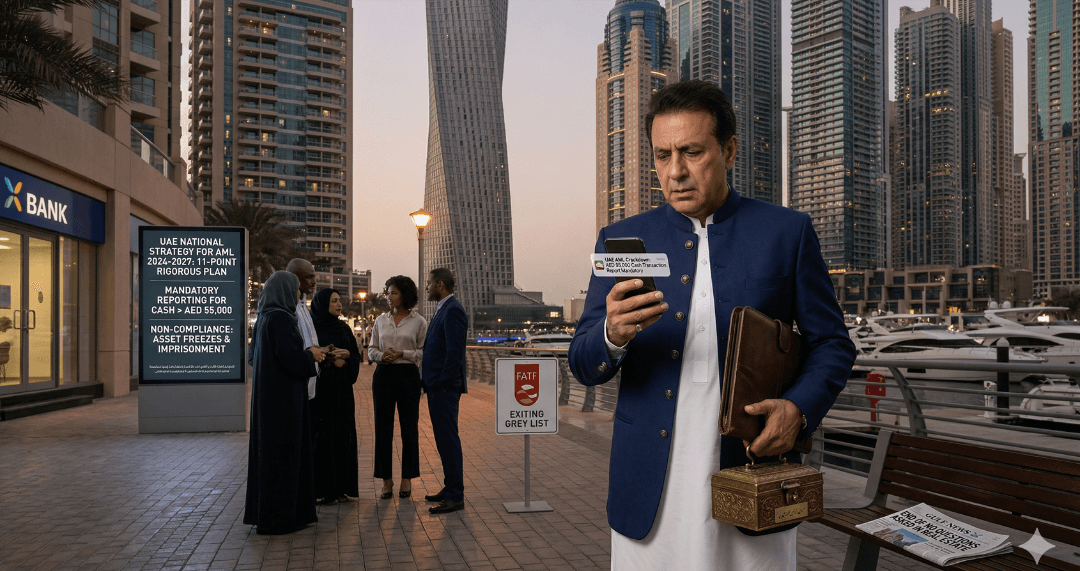
The UAE's 2024-2027 National Strategy for Anti-Money Laundering outlines an 11-point plan to strengthen compliance mechanisms, with enhanced international coordination with FATF and vigilance against emerging threats. Hamid Al Zaabi, Director General of the Executive Office for AML, confirmed that the UAE confiscated over AED 5.4 billion ($1.4 billion) from December 2021 to June 2023, mainly from cases of professional and trade-based money laundering. Pbc
The real estate sector specifically is now under systematic scrutiny. Dubai real estate firms are now required to report cash transactions exceeding AED 55,000 for occasional transactions, assess ongoing business relationships based on risk, and screen high-risk buyers. Failure to comply carries severe penalties, including license revocations, asset freezes, and fines of up to AED 50 million for corporations, alongside imprisonment of 5 to 10 years for individuals. Dawn
The "bags of cash" era of off-plan property purchases, the era that enabled 22,000 Pakistani nationals to park $12.5 billion in Dubai concrete, is definitively over. With FATF's fifth round mutual evaluation of the UAE scheduled to commence in 2026, regulators are focused on demonstrating sustained enforcement. Businesses in the UAE should expect increased levels of regulatory interest through risk assessments, audits, and investigations. Mettis Global
For Pakistani property holders whose assets were acquired with undeclared wealth, this is not an abstract compliance concern. It is a direct threat to their ability to hold, rent, or sell those assets without attracting the attention of UAE regulators who are now actively cooperating with international law enforcement under 45 mutual legal assistance treaties, with plans to sign new treaties in 2024 and 2025. The Express Tribune
The Threat to the Gulf Oasis: February 28, 2026
Then came the missiles.
On February 28, 2026, US and Israeli coordinated strikes on Iran killed Supreme Leader Ali Khamenei and targeted Iran's nuclear programme and military infrastructure. Iran retaliated fast, launching strikes across the Gulf, hitting Bahrain and the UAE. OICCI What followed was not a surgical strike on a military installation that could be quietly managed. It was an assault on the very symbols of Dubai's brand.
A drone struck near the Fairmont The Palm Hotel on Palm Jumeirah, causing a large explosion and fire. Debris from the Burj Al Arab, the sail-shaped, seven-star tower that has served as the global symbol of Dubai's luxury, caught fire on its outer facade. Dawn Dubai International Airport, the world's busiest for international traffic, was struck by Iranian munitions. International airports in Dubai, Abu Dhabi, and Kuwait were all hit, leading airlines to suspend flights across the Middle East. ProPakistani
The human toll landed with painful specificity on the Pakistani community itself. A Pakistani national was killed in Baniyas from debris from an intercepted ballistic missile. A Pakistani driver was confirmed dead after falling debris struck a vehicle in the Al Barsha area. Arab News Three of the civilians killed across the UAE were migrant workers from Pakistan, Nepal, and Bangladesh. ProPakistani The same community that had provided Dubai with its labour force, the drivers, the construction workers, the domestic staff who made the luxury economy function, were among the first to die when the missiles arrived.
As of March 17, 2026, Iran has fired 314 ballistic missiles, 15 cruise missiles, and 1,672 unmanned aerial vehicles at the UAE. Most were intercepted by UAE air defences, but interception debris and falling projectiles fell on populated areas in Abu Dhabi and Dubai, causing damage to civilian infrastructure and starting fires. Arab News
The reaction from the analyst community was unambiguous about what had been shattered. As Cinzia Bianco, an expert on the Persian Gulf at the European Council on Foreign Relations, wrote: "This is Dubai's ultimate nightmare, as its very essence depended on being a safe oasis in a troubled region." Pakistan Observer Sinem Cengiz, a researcher at Qatar University's Gulf Studies Center, captured the unprecedented nature of the assault: "For the first time in history, all GCC states were targeted by the same actor within 24 hours. Their long-standing nightmare scenario has happened." OICCI
The Vulnerability of Real Estate: When Concrete Becomes a Liability
You cannot move a luxury villa in Palm Jumeirah when drones are circling over Palm Jumeirah. This is the fundamental, irreducible problem facing Pakistani elites who staked their capital in Gulf concrete.
The property market data tells the story with brutal precision. Figures from the Dubai Land Department show that in the first full week of the conflict, the number of property market transactions fell by half. The News Pakistan This is not a minor sentiment wobble. This is a halving of transaction volume in the world's most liquid real estate market, in a single week.
The pre-existing vulnerabilities compound the crisis. Even before the first missile fell, warning signs were accumulating. In September 2025, UBS estimated that Dubai had the fifth-highest bubble risk of 21 major cities. Dawn Fitch Ratings' Anton Lopatin said the effect on real estate values will depend on the conflict's scope and duration, adding that expatriate departures could "put pressure" on Dubai's housing market. Fitch had predicted a correction of as much as 15% for 2025-2026 even before the conflict. Dawn
For Pakistani property holders, the critical issue is not just current values. It is liquidity. The market for luxury Gulf real estate is inherently thin, particularly at the high end where Pakistani capital has been disproportionately concentrated. Even in normal conditions, selling a portfolio of Dubai villas is not like liquidating shares on an exchange. In a conflict environment, with buyer sentiment collapsed, deal timelines are lengthening and new buyer enquiries have softened compared with the robust activity seen in late 2025 and early 2026. EY
The broader regional picture offers no comfort. The oil-rich federation has relied on its image as a place of serenity to lure wealthy tourists, businesspeople, and future residents who want to live largely tax-free in luxury in the desert by the sea. That peaceful image was shattered as Iranian weaponry rained down on Dubai, setting fire to a five-star resort, threatening the world's tallest building, and killing and injuring people at the capital's airport. Pakistan Observer
The Jebel Ali Port, the regional hub through which Pakistani corporate interests channel significant trade, was also struck. Factors pressuring the bond market include surging shipping insurance premiums through the Strait of Hormuz and the suspension of Jebel Ali port operations. PwC The commercial infrastructure underpinning Pakistani business interests in the Gulf is not merely at risk. Parts of it have already been physically damaged.
The Great Pullback: Panic at the Exit
What we are witnessing now is a frantic, and largely futile, reversal of capital flight.
Pakistani corporations that proudly diverted industrial liquidity into UAE transport logistics and commercial real estate are now scrambling to assess their exposure. The strategic rationale that drove these investments, tax efficiency, regulatory permissiveness, political stability, has been invalidated simultaneously on all three dimensions. The UAE has tightened its AML regime. The ballistic missiles have destroyed the stability narrative. And the tax efficiency of holding a Dubai asset means nothing if the asset cannot be sold without triggering a money laundering investigation.
The private jet market told its own story about the scale of panic. Costs to flee the country by private jet were as high as $250,000 on March 3, 2026. Several reports were issued on pets being left abandoned in the streets of Dubai by fleeing expats. Arab News These are not the actions of investors calmly rebalancing a portfolio. This is raw, primal flight, the kind that destroys asset values because sellers outnumber buyers by orders of magnitude.
For Pakistan's high-net-worth individuals attempting to liquidate, the options are constrained and expensive. The European jurisdictions that represent the most credible alternatives, London, Geneva, Lisbon, are dramatically more expensive, carry serious beneficial ownership disclosure requirements under European AML directives, and offer none of the governance permissiveness that made Dubai attractive in the first place. Moving $12.5 billion of largely undeclared Pakistani wealth from Dubai concrete into regulated European financial systems would require documentation that many of these wealth holders cannot produce without exposing themselves to prosecution in Pakistan, the UK, or both.
The result is a trapped class of capital: too hot to hold comfortably in a conflict zone, too dirty to move cleanly into legitimate jurisdictions, and too illiquid to monetize quickly in a market where transactions have halved overnight.
The Irony at the Heart of the Disaster
There is a bitter, structural irony embedded in this crisis that deserves to be named explicitly.
The same Super Tax that Pakistan's industrial class has spent years condemning as a fiscal guillotine, the levy that has driven them to shut factories, lay off workers, and divert capital offshore, created the very incentive structure that put their wealth in the crosshairs of Iranian missiles. If Pakistan had maintained a rational, competitive tax regime that made domestic industrial investment financially viable, the capital now sitting in damaged Dubai real estate portfolios might instead be sitting in spinning mills, weaving units, or export processing zones in Karachi, Faisalabad, and Lahore.
The FBR's extractive approach did not merely damage Pakistan's industrial base. It actively funded Dubai's property bubble with Pakistani industrial capital, while workers lost their jobs and foreign exchange reserves bled out. The state's fiscal pathology created a rational incentive for capital flight. Capital flight created the offshore empire. The offshore empire is now under missile attack.
The UAE has sold itself to foreigners for years as a sunny, safe, tax-free oasis. Pakistan Observer That pitch, optimized precisely for capital fleeing over-taxed, politically unstable jurisdictions like Pakistan, was always contingent on the Gulf's geopolitical stability holding. Pakistan's elites assumed that stability was permanent. They were wrong.
Conclusion: The Karma of Capital Flight
The individuals and corporations who starved Pakistan of foreign exchange, evaded taxes, and hollowed out the industrial base to build their offshore empires are now watching their wealth sit under the shadow of a regional war. The safe haven has cracked, proving that when you abandon your own country for a tax-free oasis, you are always just one geopolitical crisis away from losing it all.
The leaked data from Dubai Unlocked gave us the names. The Pandora Papers gave us the structures. The missiles gave us the consequences. What ties them together is a single, unbroken chain of political failure: a Pakistani state that could not, or would not, build a domestic environment worthy of the capital it was hemorrhaging, and an elite class that exploited every exit while leaving the workers, the taxpayers, and the creditors behind.
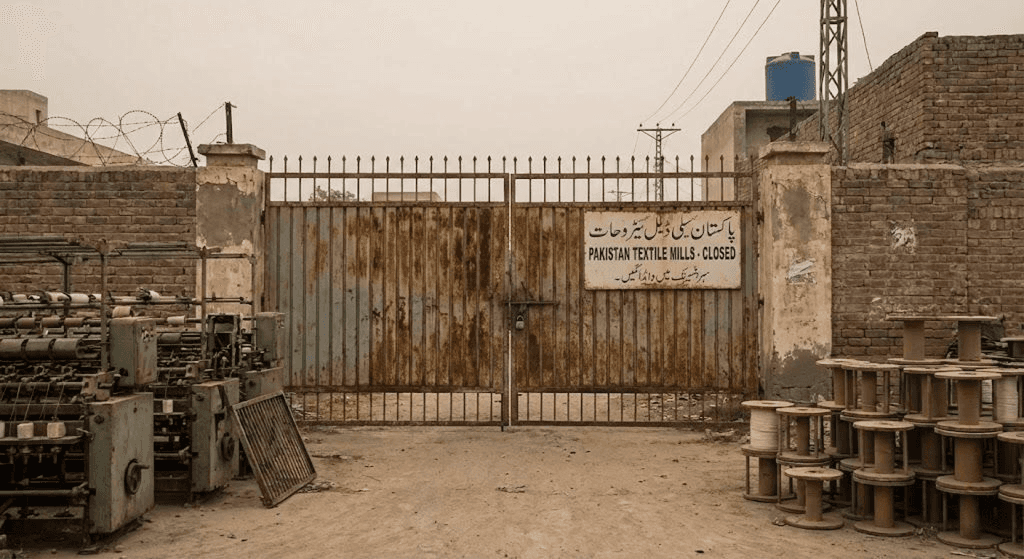
There will be those who argue, correctly, that Dubai's fundamental resilience is strong, that air defences held, that markets have not collapsed, that the UAE's diversified economy will absorb the shock. Many industry experts believe Dubai's property market fundamentals remain strong enough to absorb the shock. Dawn Perhaps. But that argument is cold comfort to a Pakistani textile mill owner who shut down his Landhi factory, threw 10,000 workers onto the streets, and parked the unlocked capital into Gulf real estate that is now generating headlines about fires at the Burj Al Arab.
The safe haven did not merely crack. It held up a mirror. And what Pakistan's elite saw in that mirror, their wealth, their choices, their abandoned country, was the true cost of the deal they made.
About

Featured Posts


Explore Topics