The Sinking Flagship: How Gul Ahmed's Hollow Revenue Hides a Terminal Decline
Is Pakistan’s textile industry sinking? Despite billions in revenue, Gul Ahmed’s profits have imploded by 95%, forcing a strategic retreat and mass layoffs in Landhi. Explore how irrational energy costs, a 10% Super Tax, and a "hollow revenue model" are hollowing out the backbone of the export economy and driving Pakistan's industrial elite to export their capital instead of their cloth.

Liam Carter
Introduction: The Great Deception
If you want to understand the terminal sickness infecting Pakistan's top exporters, you only need to look at the latest financial reports from Gul Ahmed Textile Mills.
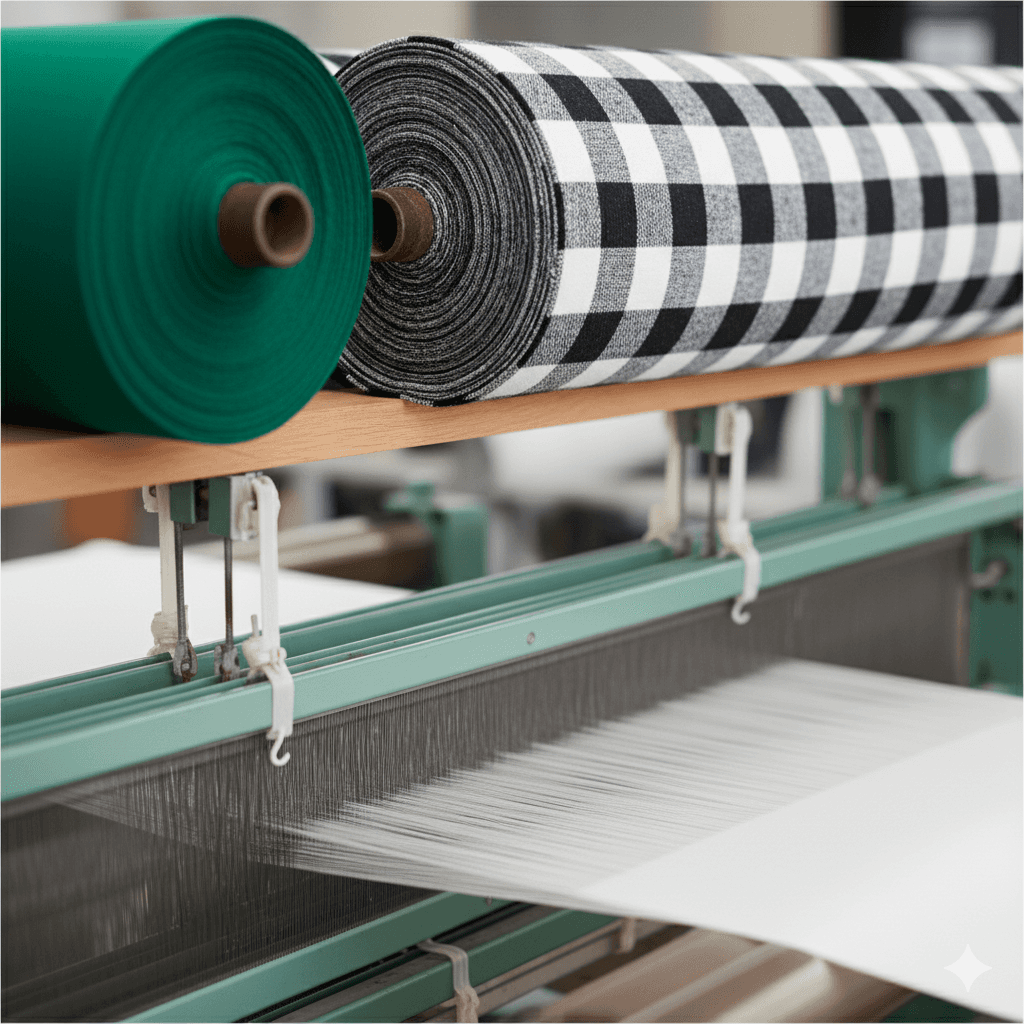
For over seventy years, Gul Ahmed has been more than a company. Incorporated in 1953 and listed on the Karachi Stock Exchange in 1970, it is a living embodiment of Pakistan's industrial ambition. With an installed capacity of more than 51,840 spindles, 300 state-of-the-art weaving machines, and the most modern yarn dyeing, processing and stitching units, Gul Ahmed is a composite unit, making everything from cotton yarn to finished products. Economy This is not a fly-by-night operation. It is a flagship.
Which is precisely why its collapse is so devastating to witness.
For years, we have placed companies like Gul Ahmed on a pedestal, celebrating their massive export volumes as a symbol of national resilience. But as we have warned repeatedly, this top-line revenue is a mirage. The giant is generating cash, but it is bleeding value. The latest half-yearly reports have vindicated our deepest fears: the flagship of Pakistan's textile sector is being hollowed out from the inside. And behind the boardroom's polished public statements lies a story of strategic retreat, worker abandonment, and capital flight, all conducted in plain sight, and cheered on by a state that refuses to ask the hard questions.
Billions in Revenue, Millions in Losses: The Anatomy of Profitless Growth
The numbers are a masterclass in what analysts now call "profitless growth."
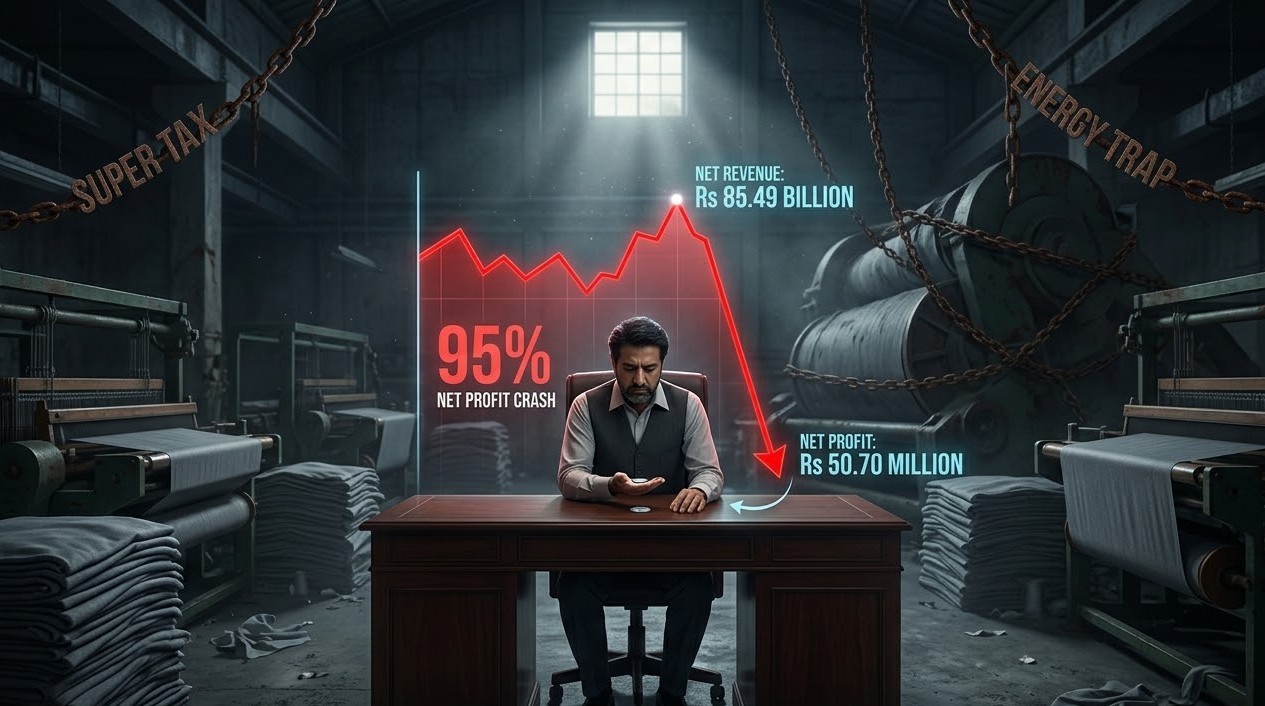
Gul Ahmed Textile Mills reported a steep decline in profitability for the half year ended December 31, 2025, posting a net profit of Rs50.70 million via other income streams, a sharp 95.04% fall compared to the net profit of Rs1.02 billion recorded in the same period last year, . The company's earnings per share fell to Rs0.07, down from Rs1.38 in the corresponding period of the previous year, showing the significant compression in bottom-line returns. Waystax
Read that again. A company that has been weaving cloth since before Pakistan was a decade old earned less in six months than it costs to buy a mid-range apartment in Defence Housing Authority. The company generated net revenue of Rs85.49 billion during the half-year, compared to Rs94.60 billion in the same period last year, a 9.63% decline pointing to softer demand or pricing pressures. Against this revenue, the cost of sales stood at Rs73.82 billion, resulting in a gross profit of Rs11.67 billion, a 13.53% contraction from Rs13.50 billion in the prior period. Waystax
This implosion did not happen overnight. The trajectory has been deteriorating quarter after quarter. As early as Q1 FY25, Gul Ahmed posted a 40.2% decline in net profit despite higher revenue, earning just Rs356.94 million compared to Rs596.79 million in the same period the prior year. Gross margins fell to 8.5% from 11.2%, with the cost of sales surging 21.7%. The News Pakistan The direction of travel was already unmistakable. By the time the half-year results confirmed the 95% crash, it was not a surprise. It was the logical destination of a journey that began the day Pakistan decided to make production a punishable act.
The longer-term picture is no more reassuring. Gul Ahmed's net profit tumbled 14.91% to Rs4.02 billion in FY2025, with a net profit margin of just 2.55%. The company's gearing ratio ticked up from 57% in 2024 to 59% in 2025, reflecting increasing reliance on borrowed capital simply to maintain operations. Dawn A textile giant with Rs157 billion in annual sales and a 2.55% net profit margin is not a business. It is a very expensive machine for moving money from banks to the FBR.
The Cost of Survival: Two Vices, One Company
How does a company move Rs85 billion worth of goods and barely make enough profit to fund its own security guard payroll? The answer lies in two interlocking vices from which Pakistani manufacturers cannot escape.
The Energy Trap
The energy cost facing Pakistani textile manufacturers is not merely a competitive disadvantage. It is an industrial death sentence. Industrial power tariffs currently range between 12–14 cents per kilowatt-hour in Pakistan, compared to 5–9 cents in competing countries. Gas prices for captive power plants have surged from Rs1,100 per million British thermal units to Rs3,500/MMBtu over the past two years, rendering gas-fired captive power generation more expensive than grid electricity. The Express Tribune
APTMA Chairman Kamran Arshad has been explicit about what these numbers mean at ground level. He identified a "triple threat" of exorbitant energy costs, heavy taxation, and high interest rates as the primary drivers of industrial decline, stating plainly that electricity and gas have become "unaffordable for the sector." Dawn Former APTMA Chairman Asif Inam made the regional comparison with surgical precision at the time of Gul Ahmed's apparel segment closure: Pakistani exporters pay 12–14 cents per unit of electricity, while Indian mills pay 5–8 cents. The sector has imported modern machinery, some as recently as 2022, which could generate $7 billion in exports if supported with cheaper power and lower interest rates. "This machinery," he lamented, "is currently sitting idle." Aaj English TV
APTMA's presentation to the National Electric Power Regulatory Authority (NEPRA) quantified the threshold of viability with precision: power tariffs now exceed the critical threshold of 12.5 cents/kWh that makes the industry uncompetitive and forces firms to shut down. Once rates go beyond 9 cents/kWh, the industry can't grow, and existing units decrease rapidly. If tariffs hit 1.5 times the Regionally Competitive Energy Tariff, firms become uncompetitive and shut down. The Nation Pakistan is operating its textile sector at nearly double the threshold of viability. Gul Ahmed's 2.55% margin is the mathematical proof.
The Tax Guillotine
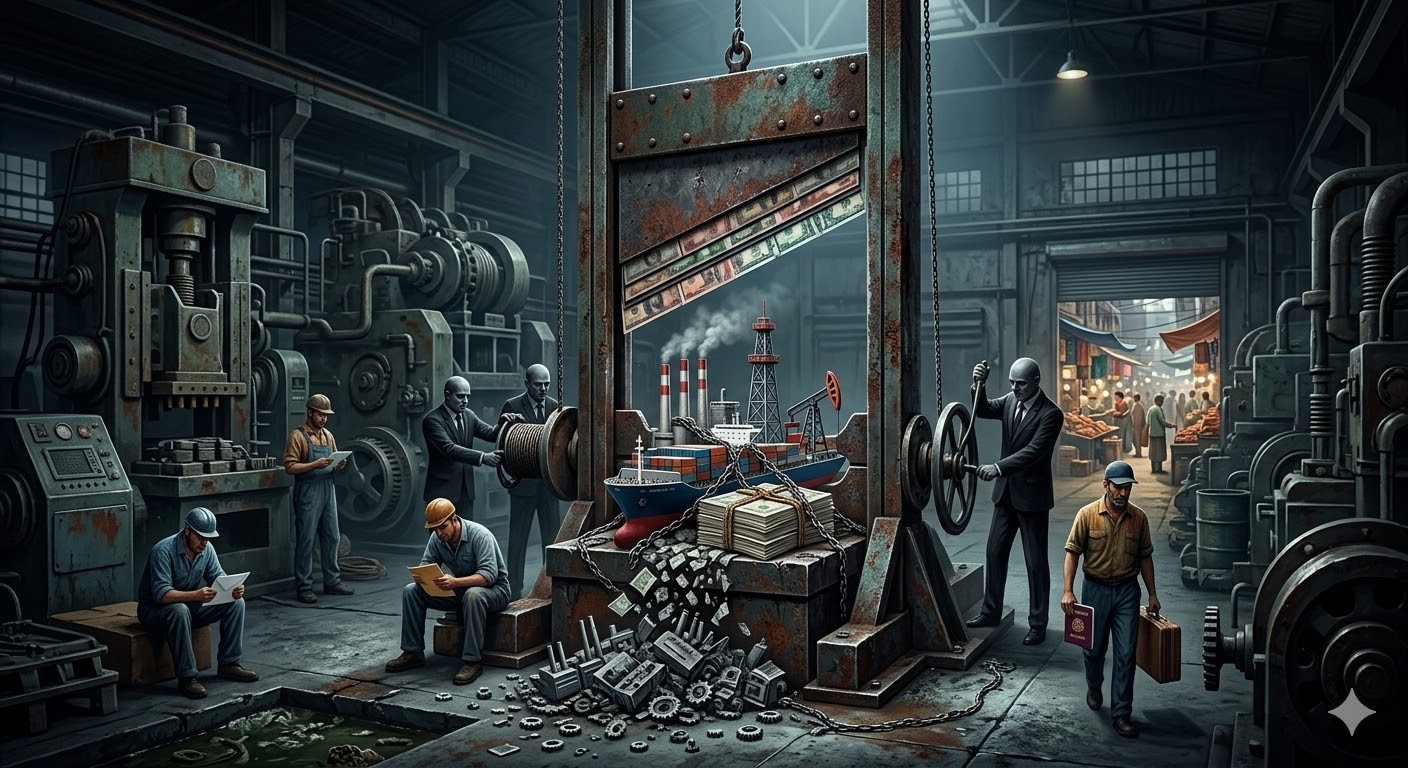
If energy costs are the slow poison, the tax regime is the accelerant. Every piece of cloth woven in Gul Ahmed's remaining units is practically subsidized by the company's own flesh. The company's own financial disclosures confirm the scale of the tax contingencies provisioned against it, with massive post-dated cheques issued to customs authorities and bank guarantees maintained to cover import duties, guarantees of Rs5,083 million have been issued by banks on behalf of the company, secured against stores, stock-in-trade, and receivables. Crowe
The combined effect, 29% corporate tax, up to 10% Super Tax, advance turnover taxes, delayed refunds, leaves manufacturers with no capital for reinvestment. Gul Ahmed itself cited tax changes, specifically an increase in advance turnover tax, as a direct cause of the sustained margin pressures that ultimately forced the closure of its export apparel segment. Aaj English TV The FBR does not merely tax Gul Ahmed's profits. It taxes its survival instinct.
The Long-Term Damage: The Apparel Segment's Last Breath
An Industry-Shaking Decision
On September 29, 2025, Gul Ahmed's Board of Directors made a decision that sent a shockwave through Pakistan's entire textile sector. Gul Ahmed Textile Mills announced the closure of its export apparel segment owing to persistent losses and structural challenges. The decision was approved by the Board at a meeting on September 29, 2025, and submitted as a formal notice to the Pakistan Stock Exchange. Aaj English TV
The company's own language was damning. The labour-intensive segment faced sustained margin pressures from regional competition, a stronger rupee, rising fabric costs, higher energy tariffs, and tax changes. These factors eroded the cost structure, causing prolonged losses. Aaj English TV
AKD Securities textile analyst Usama R. Gurmani offered an assessment that doubles as an obituary for the entire garment export model: "The apparel segment internationally is commoditised, with fierce competition pushing Pakistan into a 'race to zero' on prices, resulting in thin margins and unviable exports under the current tax regime." Aaj English TV A race to zero. That is the destination the state's economic policy has set for Pakistan's most labour-intensive export category.
The Workforce Rationalization
The human toll is embedded in the corporate filings, if you know where to look. Despite expanding revenues, Gul Ahmed rationalized its workforce from 16,082 employees in 2024 to 15,496 employees in 2025 Dawn, a reduction of nearly 600 jobs even before the apparel closure. The closure of the export apparel segment, which by its nature is among the most labour-intensive operations in any textile mill, represents a further and more severe blow to workers in Landhi's industrial area. These are not redundant middle managers being restructured. These are stitching workers, embroidery operators, and quality checkers, the human hands of Pakistan's most celebrated export industry.
APTMA's Southern Zone Chairman Naveed Ahmed placed this human reality in its starkest context: "Industrial workers are being rendered unemployed by shutting down units, and this runaway unemployment will bring about a major challenge." Dawn
The Sector-Wide Bloodbath: Gul Ahmed Is Not Alone
Gul Ahmed's crisis is not an isolated corporate failure. It is a headline case study in a sector-wide catastrophe.
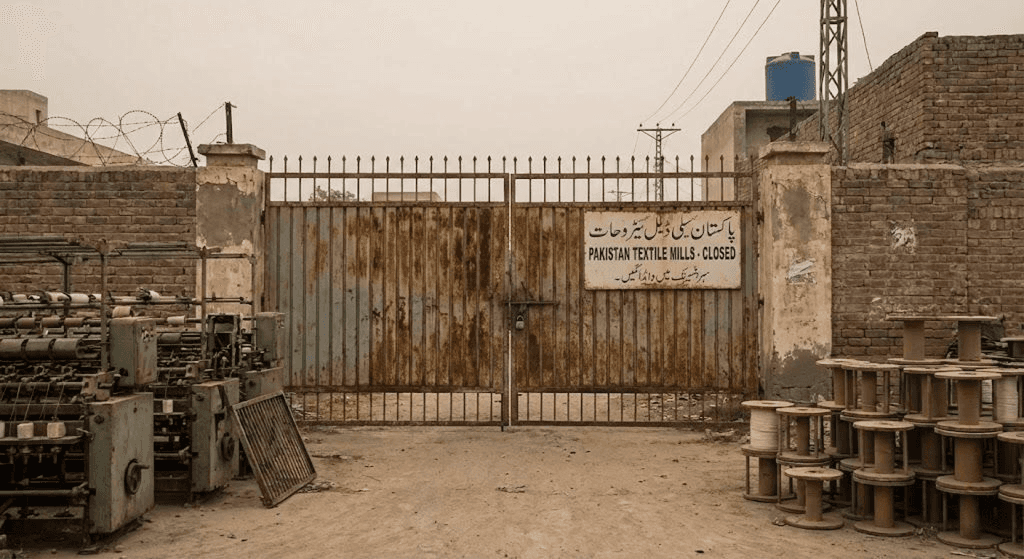
The All Pakistan Textile Mills Association has announced that 144 textile mills have already ceased operations nationwide. Dawn A separate tally placed the figure even higher. APTMA said around 150 textile units have shut down due to high gas and electricity tariffs, elevated interest rates, heavy taxation and delayed refunds. The shutdowns have reduced production, weakened exports and resulted in job losses. Arab News
Trade data shows textile exports fell to $1.43 billion in November 2025, down 2.05% year-on-year. Overall exports declined 15.35% during the month, while imports rose 5.42%, widening the trade deficit to $2.86 billion, nearly 33% higher than last year. Arab News
The trajectory is a continuous, documented downward slide. Pakistan has failed to surpass, or even maintain, the FY2021 export benchmark of $19.3 billion. Instead, exports slipped to $18 billion, then $17 billion, and continue to fall. Between July and November 2025 alone, exports dropped by 6.39%, from $13.721 billion to $12.844 billion. OICCI
The APTMA has described the structural logic of this collapse with clarity: escalating energy prices threaten the survival of the sector, with exports stagnating and Pakistan losing market share to competitors like Bangladesh, India, and Vietnam. "This crisis compounds the country's weak macroeconomic outlook, characterised by high inflation and vulnerability, exacerbating unemployment and poverty while straining power sector revenue." ProPakistani
Kohinoor Mills CEO Aamir Fayyaz Sheikh offered a number that should have triggered a national emergency response: Pakistan's overall market share in the textile and garment industry was nearly 2.25% about two years ago. Now it's down to around 1.7%. The Nation Half a percentage point of global market share lost in two years. In an industry that Pakistan's own government describes as the backbone of its export economy.
The Dubai Detour: Exporting Capital, Importing Misery
This brings us to the most treacherous dimension of the corporate playbook, one that Gul Ahmed's management has executed with the efficiency they could no longer manage in their factories. As we exposed previously, Gul Ahmed's international corporate structure is worth examining carefully. The group's international holding company is Gul Ahmed International Limited (FZC), a wholly owned UAE subsidiary, which in turn owns GTM Europe Limited in the UK, GTM USA Corp., and Sky Home Corp. in the United States. Economy
This is the architecture of a company that long ago understood it needed its most valuable assets at arm's length from Pakistan's fiscal authorities. The UAE entity does not merely serve as a trading intermediary. It is the vehicle through which the group's international cash flows are routed and retained outside the reach of an FBR that has proven itself incapable of restraint.
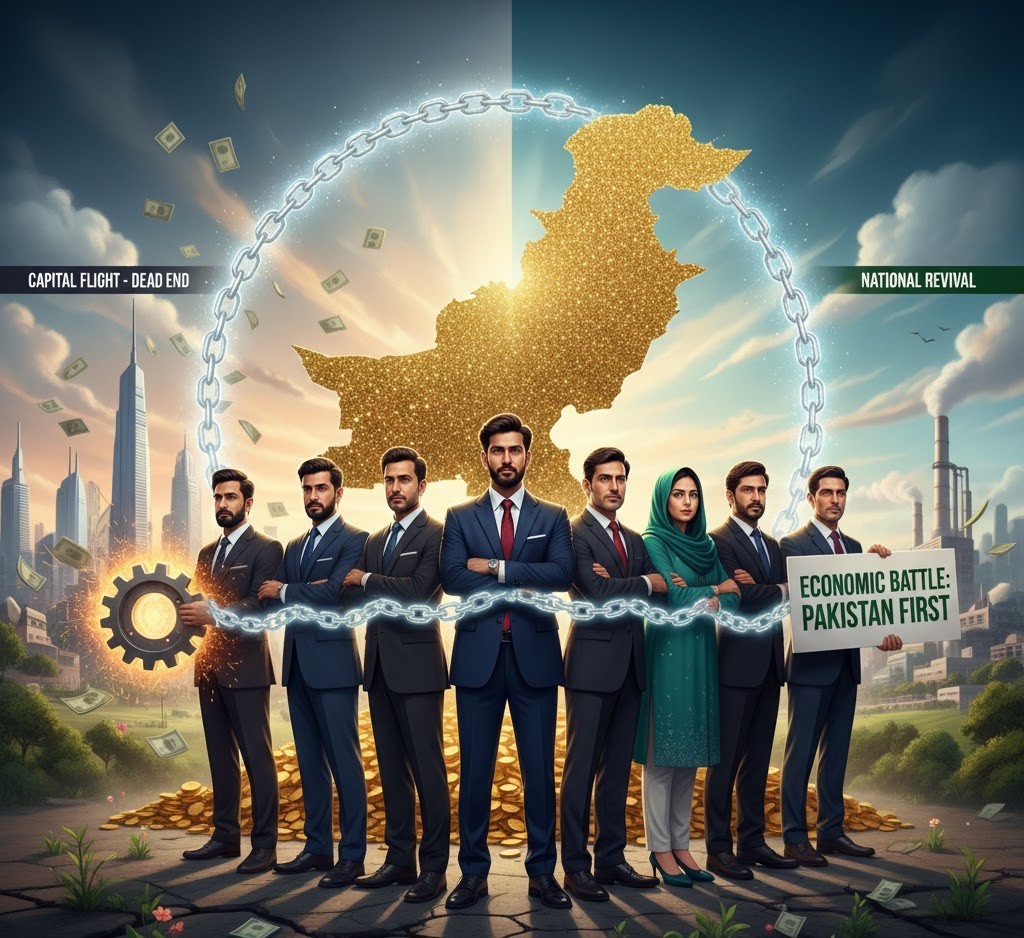
The pattern is not unique to Gul Ahmed. It reflects a rational response by Pakistan's industrial elite to an irrational policy environment. When the state extracts 50% of your documented earnings in combined levies, parks its own inefficiencies in your electricity bill, and then retroactively re-prices your tax obligations across a decade, the rational actor does not double down on domestic investment. They create distance. They diversify into jurisdictions where the rules do not change overnight. They liquidate their most vulnerable operations, the apparel segment, the spinning units, the labour-intensive work, and preserve their capital in structures the FBR cannot easily reach.
The workers in Landhi bear the full cost of this rational calculus. The board members bear none of it.
The Vicious Loop: How the Hollow Revenue Model Sustains Itself
Understanding how Gul Ahmed maintains Rs85 billion in revenue while posting Rs50 million in profit requires understanding the mechanics of the hollow revenue model.
The company is not growing. It is cycling. Export sales volumes, measured in units of cloth, yarn, or finished goods, are under sustained pressure from cheaper regional competitors. Competing exporters in Bangladesh, Vietnam, India, and Sri Lanka benefit from lower energy costs, more stable tax regimes, and targeted export support, placing Pakistan at a structural disadvantage. Arab News PK What appears as revenue is largely the effect of currency devaluation repricing existing inventory in rupee terms, or existing export cycles maintained through subsidized export refinance schemes.
APTMA identified one of the most destructive downstream effects of this dynamic: textile manufacturers are shifting toward imports, with yarn imports rising from 8 million kilograms in January 2024 to 32 million kilograms in January 2025. Greige cotton cloth imports increased from 2 million kilograms to 5 million kilograms in the same period. The Express Tribune Pakistani manufacturers, unable to source domestic inputs at competitive prices, are using export financing to import their raw materials. They are, in effect, acting as pass-through entities, converting subsidized credit and duty exemptions into export receipts, while the actual value creation happens in Bangladesh, China, or Vietnam.
This is the hollow core. Revenue cycles fast. Profit margins die. Workers lose jobs. Capital exits. And the FBR celebrates its collection numbers.
Conclusion: Stop Cheering for the Undertaker
Gul Ahmed's financial downfall is not a story about one company's mismanagement. It is a story about what happens when a state turns its most productive citizens into its most reliable victims.
The Rs50.7 million profit on Rs85 billion in revenue is the financial equivalent of a dying man's pulse: technically present, structurally meaningless. The closure of the export apparel segment is not a restructuring. It is an amputation. The strategic closure will reduce losses, lower borrowing, and improve cash flow Aaj English TV, which is management-speak for: we have stopped trying to win and have begun managing the retreat.
APTMA has issued its warning in terms that admit no ambiguity: without urgent policy interventions, Pakistan's textile sector will continue to lose its competitive edge, leading to further deindustrialization, job losses, and declining foreign exchange earnings. The Express Tribune
We are cheering for massive revenue cycles while ignoring the mass layoffs, the closed factory gates, and the capital quietly finding its way to UAE holding structures. It is time the state stops treating these hollowed-out giants as national heroes and starts asking what they owe the workers they discarded, the communities they abandoned, and the country whose subsidized gas and export financing they consumed on their way out.
The undertaker is not your enemy. But you should stop celebrating his work as if it were growth.
About

Featured Posts

Explore Topics